Showing posts with label G. K. Chesterton. Show all posts

4/9/17

One of my favorite poems for Palm Sunday is "The Donkey" by G. K. Chesterton. The poem captures the idea that God uses the lowly, the odd, and the strange for His purposes.

The early part of this poem reminds us that the donkey is an odd animal. The first stanza refers to the the medieval belief that one's personality/destiny was determined by the alignment of celestial bodies at the moment of one's birth. So the donkey was supposedly born at a moment when "the moon was blood" and other strange things were going on in nature. The point is that the donkey is an odd animal. As beasts go, the donkey is definitely outside the mainstream.

The second and third stanzas continue the idea that the donkey is worthy of ridicule: it has a "monstrous head," and "ears like errant wings." It's "the devil's walking parody / on all four-footed things." And Chesterton is right: we don't admire donkeys for their beauty or their intelligence. To this day, to call a person a donkey (or in older terms, an "ass") is quite an insult.

But the last stanza shows the donkey's triumph. Of all the beasts on this planet, the Savior chose only one--the donkey--when He rode into Jerusalem on that Palm Sunday long ago, that "far fierce hour and sweet." In that moment, the donkey was given an honor beyond all other beasts in history. And this poem captures that moment beautifully.

     The Donkey

     When fishes flew and forests walked
     And figs grew upon thorn, 
     Some moment when the moon was blood
     Then surely I was born;

     With monstrous head and sickening cry
     And ears like errant wings,
     The devil's walking parody
     On all four-footed things.

     The tattered outlaw of the earth,
     Of ancient crooked will;
     Starve, scourge, deride me: I am dumb,
     I keep my secret still.

     Fools! For I also had my hour;
     One far fierce hour and sweet:
     There was a shout about my ears,
     And palms before my feet.

10/17/13

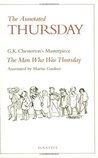
The Annotated Thursday: G. K. Chesterton's Masterpiece The Man Who Was ThursdayThe Annotated Thursday: G. K. Chesterton's Masterpiece The Man Who Was Thursday by G.K. Chesterton
My rating: 4 of 5 stars

When I read this 15 years ago or so, I didn't get it. This time I got it: this is Job 38-42 in allegorical form.

Like much of Chesterton's other work, the story begins lightheartedly, but by the end it becomes profound. At the beginning, the main character finds himself getting caught up as an undercover detective in a secret organization that plans to destroy the world, and he is carried along through some great plot twists and turns and chases. As the story progresses, however, things get stranger--much stranger. The fantasy elements multiply, and by the end, the tone has completely shifted. This genre-mixing isn't everyone's cup of tea, but the story certainly provokes thought.

This particular edition includes a lot of great annotations from scholar Martin Gardner, including background on the novel's cultural references, geographical references, and other interesting tidbits.

View all my reviews

2/18/13

“Thoroughly worldly people never understand even the world; they rely altogether on a few cynical maxims which are not true. Once I remember walking with a prosperous publisher, who made a remark which I had often heard before; it is, indeed, almost a motto of the modern world. Yet I had heard it once too often, and I saw suddenly that there was nothing in it. The publisher said of somebody, 'That man will get on; he believes in himself.' And I remember that as I lifted my head to listen, my eye caught an omnibus on which was written "Hanwell." I said to him, "Shall I tell you where the men are who believe most in themselves? For I can tell you. I know of men who believe in themselves more colossally than Napoleon or Caesar. I know where flames the fixed star of certainty and success. I can guide you to the thrones of the Super-men. The men who really believe in themselves are all in lunatic asylums." He said mildly that there were a good many men after all who believed in themselves and who were not in lunatic asylums. "Yes, there are," I retorted, "and you of all men ought to know them. That drunken poet from whom you would not take a dreary tragedy, he believed in himself. That elderly minister with an epic from whom you were hiding in a back room, he believed in himself. If you consulted your business experience instead of your ugly individualistic philosophy, you would know that believing in himself is one of the commonest signs of a rotter. Actors who can't act believe in themselves; and debtors who won't pay. It would be much truer to say that a man will certainly fail because he believes in himself. Complete self-confidence is not merely a sin; complete self-confidence is a weakness. Believing utterly in one's self is a hysterical and superstitious belief like believing in Joanna Southcote: the man who has it has 'Hanwell' written on his face as plain as it is written on that omnibus." And to all this my friend the publisher made this very deep and effective reply, "Well, if a man is not to believe in himself, in what is he to believe?" After a long pause I replied, "I will go home and write a book in answer to that question." This is the book that I have written in answer to it.”

Gilbert Keith Chesterton, Orthodoxy

2/5/13

“Here dies another day
During which I have had eyes, ears, hands
and the great world around me; 
And with tomorrow begins another.
Why am I allowed two?”

“Evening” by G. K. Chesterton

6/14/12

The Ballad of the White HorseThe Ballad of the White Horse by G.K. Chesterton
My rating: 3 of 5 stars

I read this long poem because C. S. Lewis loved it and because I'm simply fascinated by Anglo-Saxon history and culture. This poem is the partially historical, partially idealized story of King Alfred, the ninth-century Saxon king who defended his kingdom successfully against the Danes. (To this day, he's still the only English monarch known as "the Great.")

As someone who is familiar with English history but not an expert in it, I found the poem hard to follow in places (geography, historical references, etc.). I also found some of the slower passages tedious. (I should note that these are not Chesterton's faults as a writer, but mine as a reader.) But overall this is a good story that includes heroism, adventure, and the triumph of virtue. I also enjoyed how Chesterton, true to form, weaves a defense of Christianity (well, Catholicism) into the narrative.

I put only three stars because after having read it only once, I feel like I need to read it again to really let it get into my imagination so that I can savor it and enjoy it more.

As a postscript, this poem is the source of these famous lines:

"For the great Gaels of Ireland
Are the men that God made mad,
For all their wars are merry,
And all their songs are sad."


View all my reviews