Showing posts with label J. R. R. Tolkien. Show all posts

10/1/16

The Silmarillion (Middle-Earth Universe)The Silmarillion by J.R.R. Tolkien
My rating: 4 of 5 stars

This was much better the second time through, now that I had a basic familiarity with the world Tolkien has created.

The Silmarillion consists of the entire history of the Elves of Tolkien’s world. It shows the vastness of Tolkien’s imagination. The stories are varied: Some are glorious, some are heroic, many are sad . . . I really wish he would have developed them in more detail.

Beyond the stories, the book makes me reflect on the concepts of creation, fall, and redemption.

At first, the world Tolkien has created is beautiful and good in its unfallen glory. Actually, it’s probably similar to what this world would have been had it been developed for hundreds of years. Before the Elves leave Valinor, they have developed a beautiful culture of cities, light, and song. Ages pass, during which the Elves thrive, creating a glorious, peaceful world. Overall, in the first part of The Silmarillion, Tolkien incites our imagination to think of the world we could have had—more glorious than we can comprehend.

But in Tolkien’s world, like ours, there is a Fall. A fallen Vala (the Valar are essentially archangels who are entrusted with the rule of the world) seduces Feanor, an Adam figure, to rebel against the other Valar. Once Feanor rebels, evil begets evil, and it spreads until the whole world is infected. The whole book is really the working out of this Fall. Eventually, most of the Elves leave Valinor, and they build hidden kingdoms in Middle Earth, such as Gondolin and Rivendell. Over the ages, these hidden kingdoms fall or fade away.

The redemption of Tolkien’s world is really unfinished, but it’s interesting that Tolkien emphasizes the working out of Providence in the world’s affairs. In The Silmarillion, it is the will of Providence for the Elves to go back into the West so that the Age of Man will commence. Although the book ends with the same scene as The Lord of the Rings—the White Ship leaving from the Grey Havens—the emphasis is on the fact that this ship is leaving with the last of the Elves. This is because the Elves’ work is finished in Middle Earth, and now the Age of Man has fully come—and again, this is by the will of Providence.

Finally, I enjoyed Tolkien’s clever links to other legends. The Elvish haven of Avollone is a reference to Avalon of the Arthurian tales. Another reference to other myths is Atalante, or the island (continent?) of Numenor. Like Atlantis, Numenor is destroyed in cataclysm and swallowed up by the ocean. And finally, the character of Earendil (Elrond’s father) is an Odysseus figure—a wandering mariner about whom there are many tales.


View all my reviews

6/22/16

The Return of the King (The Lord of the Rings, #3)The Return of the King by J.R.R. Tolkien
My rating: 5 of 5 stars

I would agree with C. S. Lewis’s assessment of The Lord of the Rings: “Here are beauties which pierce like swords or burn like cold iron; here is a book that will break your heart."

First, I loved the sense of solemnity, or “pomp” in the old sense of the word, that emerges in Return of the King, especially in regards to Aragorn’s transformation from Strider into the King of Gondor. We Americans are so democratic/egalitarian that we don’t fully understand the solemnity of a monarch coming into his realm. But I love the scenes where Aragorn is crowned and where the city honors him. The language is formal. The ceremoniousness is appropriate. The tradition is deep. (It’s surreal reading these scenes while Donald Trump and Hillary Clinton are running for president.) There’s something good about formality and tradition and grandeur in a monarchy that we democrats (small "d") can’t really understand.

Second, the language. Tolkien has a wonderful sense of poetry in his prose. I enjoyed the poems he mixes in here and there, but even more, I love the way Tolkien elevates his prose to heighten a character’s emotion during a significant point in the story. Throughout the work, in scenes where a character experiences something unusually powerful, Tolkien adds figures of speech—metaphor, alliteration, formality. It reminds me of the way some of Shakespeare’s characters change from prose to iambic pentameter when they express powerful feelings.

One modest example is Sam’s attempt to describe Galadriel to Faramir: “I wish I could make a song about her. Beautiful she is, sir! Lovely! Sometimes like a great tree in flower, sometimes like a white daffadowndilly, small and slender like. Hard as di’monds, soft as moonlight. Warm as sunlight, cold as frost in the stars. Proud and far-off as a snow-mountain, and merry as any lass I ever saw with daisies in her hair in spring-time.”

A better example is Theoden’s summoning of the riders of Rohan just before they charge into the forces of Mordor besieging Gondor. As Theoden calls them to battle, his words have the alliteration of Anglo-Saxon poetry:

“Now is the hour come, Riders of the Mark, sons of Eorl! Foes and fires are before you, and your homes far behind. Yet, though you fight upon an alien field, the glory that you reap there shall be your own forever. Oaths ye have taken: now fulfil them all, to lord and land and league of friendship! . . . Forth now, and fear no darkness!”

Finally, throughout the series, I have also appreciated Tolkien's sense of place. The journey from the Shire finds its meaning in the simple, quiet goodness of the Shire itself. I love the scene where Pippin and Merry meet each other at long last in Minas Tirith, after the Battle of the Pelennor Fields. Pippin notes, "We Tooks and Brandybucks, we can't live long on the heights."

"No," said Merry. "I can't. Not yet, at any rate. But at least, Pippin, we can now see them, and honour them. It is best to love first what you are fitted to love, I suppose: you must start somewhere and have some roots, and the soil of the Shire is deep."

There’s so much more. This series helps us appreciate the Good, the True, and the Beautiful. What a glorious, magnificent book.


View all my reviews

6/20/16

By reading more slowly, I paid more attention to the language. I understood more deeply the emotional impact of the echoes of Anglo-Saxon alliteration. I appreciated the intentionally archaic, almost liturgical language J.R.R. Tolkien uses to evoke the royal dignity of the Court of Gondor. I caught at a deeper level the characterization caught in the voices of Gollum—so slimy and slippery—or Sam, so simple and true. I also slowed down and took time with Tolkien’s long passages of geographical and scenic description. He saw the contours of Middle Earth. Instead of racing over them for the plot as I had done before, I took time and allowed my imagination to see the landscape and thus feel the mood. The effect of the language and the descriptions is to evoke emotion, and the philologist Tolkien did not fail. At several points I was caught up in the emotion and wept real tears.
Dwight Longenecker, "The Lord of the Rings: Read It and Weep"

5/30/16

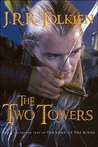
The Two Towers (The Lord of the Rings, #2)The Two Towers by J.R.R. Tolkien
My rating: 5 of 5 stars

This time through, it occurred to me that there are some parallels between Gondor at this point in the series and the nation of England at the time Tolkien was writing. Both nations had fallen from their former glory, yet not because of external strife, but because of a declining sense of nobility and virtue.

Tolkien, as a Roman Catholic and a lover of Anglo-Saxon culture, saw England at its greatest in the early medieval period, when Anglo-Saxon culture was strong, Catholicism reigned, and the language was uncorrupted yet by the Norman invasion. In contrast, Tolkien saw the England of his own time as fallen from these things into greed and decay. In The Two Towers, and in the whole series, Gondor is portrayed similarly. Gondor is great, but it is fallen from the majesty it once had.

One passage in which Tolkien communicates this idea is one of Faramir's conversations with Frodo and Sam in Ithilien. Faramir tells them, "The old wisdom and beauty brought out of the West remained long in the realm of the sons of Elendil the Fair, and they linger there still. Yet even so it was Gondor that brought about its own decay, falling by degrees into dotage. . . . We are become Middle Men, of the Twilight, but with memory of other things."

This is a good description not only of Gondor, but of England and other nations who have a heritage of former greatness and but a state of present decay.

I could go on--it's a fascinating and thought-provoking theme worth exploring in more depth.

View all my reviews

5/7/16

The Fellowship of the Ring (The Lord of the Rings, #1)The Fellowship of the Ring by J.R.R. Tolkien
My rating: 5 of 5 stars

Fourth time through, and more enjoyable than the first three times. I enjoyed . . .

1. The Shire. Having read a good bit of Wendell Berry since my last time through, I appreciate Tolkien's sense of place. The Shire is a lot like Port Royal, Kentucky. I love the quirkiness of the people, their rootedness in localities, the beauty of the landscape (in my imagination), its local history, its smallness, its lack of machinery ... It's a lot like I think heaven will be after a few hundred years. When you see the adventure as framed by the quietness of the Shire, you see the beauty and worth of quiet, decent, ordinary life.

2. Echoes of Shakespeare. I noted three or four when the Hobbits first meet Strider. This may have been unconscious, but Tolkien knew his Shakespeare.

3. I'm enjoying the poetry of Tolkien much more this time. In readings past, I honestly found the poetry a little annoying. Now I'm able to surrender to the mood of the book a bit more. Maybe it's because I'm in my late thirties. I also noticed that Tolkien loved iambic tetrameter.

View all my reviews

12/30/15

The Hobbit (Middle-Earth Universe)The Hobbit by J.R.R. Tolkien
My rating: 5 of 5 stars

This time through I noticed the theme of Providence throughout the story. So many seemingly random events are orchestrated for a higher purpose: Gandalf's choosing of Bilbo as the "burglar"; the fact that Bilbo and the dwarves happen to be at Rivendell on Midsummer's Day Eve, which happens to be the only night they can read the runes on Thorin's map; Bilbo's discovery of the Ring in the darkness of a cave; the fish that jumps out of the water and thus gives Bilbo the answer to one of Gollum's riddles that had him completely stumped; the fact that the dwarves and Bilbo are standing by the grey stone on Durin's Day as the thrush knocks and the setting sun shines light upon the keyhole.

The narrator refers to Bilbo's "good luck" throughout the book, but at the very, very end of the book, he brings out the role of Providence. Several years after the adventure, Bilbo is sitting in his living room with Balin and Gandalf, and he learns that all is well at the Lonely Mountain. Dale is rebuilt; the dwarves and the men and the elves are all getting along. Lake-town's new Master is wise and kind. Balin even tells Bilbo, "They are making sons which say that in his day the rivers run with gold."

"Then the prophecies of the old songs have turned out to be true, after a fashion!" said Bilbo.

"Of course!" said Gandalf. "And why should not they prove true? Surely you don't disbelieve the prophecies, because you had a hand in bringing them about yourself? You don't really suppose, do you, that all your adventures and escapes were managed by mere luck, just for your sole benefit? You are a very fine person, Mr. Baggins, and I am very fond of you; but you are only quite a little fellow in a wide world after all!"

View all my reviews

7/13/15

Creativity shot through with Beauty has made its impression on me; has breathed its very life into me. I find I am most shaped by images and stories, more than by essays. The essays have moulded my thoughts, certainly, but they are more abstract and intangible. Essay ideas are like trying to grasp a handful of smoke or filling our probing fingers with a bit of soul. But stories are gloriously real—even when fanciful and fantastic. Friendship becomes more than an idea, it is embodied in Samwise carrying the ring for Frodo—by carrying Frodo himself—when he had no more strength to walk toward Mount Doom. Hope is not just letters stacked together, it is Sam seeing a single star through the clouds and realising that the world is bigger than just his or Frodo’s bit in the story; bigger and grander than Mordor and him-who-shall-remain-nameless. There was still Beauty outside that transcended, it brought Sam’s mind to the meta-story in which he and Frodo were but small characters. Beauty would outshine and outlive the world of Middle Earth, even if the quest failed.

Jody Byrkett, "Creativity Begets: How Story Inspires"

12/16/14

There is real adventure to be had in God’s fantastic world, real evil to fight, real moral complexities to navigate, real sorrows to bear, real redemption to celebrate. Tolkien created Middle-earth not as an escape from the real world, but as a retreat to see our reality all the clearer and come back more wide awake to our world. . . .
Tolkien’s stories summon us . . .  not to settle for our little comforts and play spaces and semblances of control, but to dream for more, to lose ourselves in some great global pursuit, to vanquish the foe, to win the peoples.
Evil in the world is real and powerful, as Tolkien so starkly portrays. And so throughout The Hobbit, says Devin Brown, Tolkien is teaching us a lesson about . . . an invisible Hand at work in the entirety of the story.
But even more poignant than some Great Providence at every harrowing turn is the climactic moment of rescue and resolution. Which now, at long last, we come to in this third and final installment of The Hobbit. It is what Tolkien called “the Consolation of the Happy Ending” in his powerful essay “On Fairy Stories.”
Here we finally taste “the joy of the happy ending.” But don’t think that means it comes with simplicity, and that you can see it coming. Tolkien coined a term for this happy ending that “all complete fairy-stories must have.” He called it “Eucatastrophe,” which means “the good catastrophe.” It is
the sudden joyous “turn” . . . a sudden and miraculous grace: never to be counted on to recur. It does not deny the existence of . . . sorrow and failure: the possibility of these is necessary to the joy of deliverance: it denies (in the face of much evidence, if you will) universal final defeat and in so far is evangelium [the gospel], giving a fleeting glimpse of Joy, Joy beyond the walls of the world.
. . . The great insight of Tolkien’s “On Fairy Stories” is that the Christian story “is the greatest and most complete conceivable eucatastrophe.” The “Joy” we experience at the sudden climactic turn from evil to good, from death to life, from utter darkness to brilliant light, is a “gleam or echo of evangelium [the gospel] in the real world.” Says Tolkien,
The Birth of Christ is the eucatastrophe of Man’s history. The Resurrection is the eucatastrophe of the story of the Incarnation. This story begins and ends in joy. It has pre-eminently the “inner consistency of reality.” There is no tale ever told that men would rather find was true, and none which so many skeptical men have accepted as true on its own merits. . . .
 It is preeminently (infinitely, if our capacity were not finite) high and joyous. But this story is supreme; and it is true. Art has been verified. God is the Lord, of angels, and of men — and of elves. Legend and History have met and fused.
. . . For Christians, here [in The Hobbit] we find just a gleam, just a faint echo of the Joy that is, and is coming, and will shine and sound for all eternity, and satisfy our souls in that True Story for which we were made.
David Mathis, "Bilbo's Last Goodbye"

12/28/13

My life took a slight but perceptible change in direction in my late teens from reading J. R. R. Tolkien's The Lord of the Rings. Trolls, elves, hobbits, wizards, dark forests, forest havens, caves, mountain strongholds, treachery, cowardice, courage, perseverance--what have these to do with being a teenager in California during the Vietnam War?
Nothing and everything. I found embodied in that fantasy what every teenager needs to find--especially one coming of age in the moral ambiguity of the late 1960s: that there is a difference between good and evil, that the distinction is usually clear enough to act on, that fighting for good is worthwhile even if one loses, that average, even unimpressive people, can do so, and, far-fetched as it may seem, that good eventually wins out in the end--though not without lingering wounds. 
Even though there is a strong "what happens next" element in The Lord of the Rings, I was drawn not so much into the plot of the adventure as to the characters having the adventure. Maybe it is better to say that the testing of their character was the adventure for me--as I later realized it was for Tolkien as well. I discovered that I did not so much forget myself while reading the story as I found myself going along on the journey, dealing like the nonheroic, comfort loving hobbits with weariness, fear, uncertainty, and agonizing choices. With them I felt terror when confronted with undisguised evil and enormous gratefulness for unexpected good. 
 Tolkien's story gave me the courage to say to myself what I already felt true from my own experience--that good and evil are real, that it matters a great deal which one wins out in the world, and that the outcome depends on me. The Lord of the Rings is filled with unexceptional people--that is, hobbits, elves, and the like--called on to do exceptional things if good is going to survive in the world. Reading the story (and its predecessor, The Hobbit), reinforced in me a tremendous desire that good should win in the world and evil be defeated, and to do what I could to help--not least because it helped me to see that evil was not only out there, but within me as well. I genuinely believe this story helped shape who I was and am. Its characters became my character.
Daniel Taylor, "In Praise of Stories"

7/31/12

[Tolkien's] doctrine of sub-creation [the idea that man's ability to create worlds in fantasy literature is one of the ways that man demonstrates the image of the Creator of this world] was created to explain certain features of fantasy literature, [but] it is applicable to many other genres as well. Even in the most "realistic" fiction, the writer creates a world, peoples it with characters whose actions give its history significance, and determines the rules of its nature.l And usually . . . the secondary world [created by the author] echoes the primary creation [the real world, which God created] in more ways than one. The hero, at great personal sacrifice, defeats the villain and rescues the damsel in distress, and they ride off into the sunset to live happily ever after: this basic plot we keep coming back to is salvation history writ small, as it were. As Edwards says, literature is "drawn" towards a biblical reading of life. Tolkien explains why: "We make still by the law in which we're made."

Donald T. Williams, "Christian Poetics, Past and Present"