Showing posts with label Wendell Berry. Show all posts

3/12/22

[Some] people believe … that any community attempt to remove a book from a reading list in a public school is censorship and a violation of the freedom of speech. The situation here involves what may be a hopeless conflict of freedoms. A teacher in a public school ought to be free to exercise his or her freedom of speech in choosing what books to teach and in deciding what to say about them. (This, to my mind, would certainly include the right to teach that the Bible is the word of God or the right to teach that it is not.) But the families of a community surely must be allowed an equal freedom to determine the education of their children. How free are parents who have no choice but to turn their children over to the influence of whatever the public will prescribe or tolerate? They obviously are not free at all. The only solution is trust between a community and its teachers, who will therefore teach as members of the community–a trust that in a time of community disintegration is perhaps not possible. And so the public presses its invasion deeper and deeper into community life under the justification of a freedom far too simply understood. It is now altogether possible for a teacher who is forbidden to teach the Bible to teach some other book that is not morally acceptable to the community, perhaps in order to improve the community by shocking or offending it. It is therefore possible that the future of community life in this country may depend on private schools and home schooling.

-- Wendell Berry, from Sex, Economy, Freedom, and Community

3/25/17

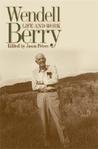
Wendell Berry: Life and WorkWendell Berry: Life and Work by Jason Peters
My rating: 4 of 5 stars

I've been reading Wendell Berry for about ten years now, and although I don't always agree with every jot and tittle in his books, I have great respect for him, and I have enjoyed and learned much from him.

In my view, his thought can be summed up in these lines from his poem "How to Be a Poet":

There are no unsacred places.
There are only sacred places
and desecrated places.

Berry helped me understand that this world is a wonderful, sacred place, and that we need to live here with a sense of gratitude, stewardship, and affection. In another of his books, he says, "I take literally the statement in the Gospel of John that God loves the world. I believe that divine love, incarnate and indwelling in the world, summons the world always toward wholeness." For Berry, love for God should not be thought of as consisting only in a spiritual realm, but should actually influence everything we do in our day-to-day activities. It should cause us to care holistically for our families, for our fellow man, and for the land God created. As Berry puts it, "It all turns on affection."

This book is an excellent, detailed summary of Berry's thought, influences on him, and his influence. Writers include Berry scholars, as well as his friends and fellow writers. I didn't read every essay, but I read most of them and found them helpful.

View all my reviews

9/8/16

The answer to "What Is an American?" goes some distance in explaining why the Joneses and those who keep up with them live not as Thoreau did, nor as Berry does, but as bundles of unacknowledged contradictions: they have treadmills in their basements and riding lawnmowers in their garages; they drive to gyms across town (and over rivers) to ride stationary bikes (and use rowing machines). These exemplary citizens have been "educated" to be self-reliant and resourceful in schools funded by state lotteries and casinos. 
Jason Peters, Introduction to Wendell Berry: Life and Work

3/4/15

It’s too easy to dismiss Berry’s thought by saying that since we can’t all move back to some idyllic, rural home, we don’t need to pay attention to him.  Berry doesn’t believe in some idyllic past, and he doesn’t think everyone should live on a farm.  He’s arguing something much more radical, in the literal sense of that word, when he claims that “to be in place is good and to be out of place is evil.”  Fortunately for us, we can acknowledge our creaturely limits and express proper gratitude even when we’re geographically placeless.  Indeed, if we could not, how could we ever find our way back home?

Jeffrey Bilbro, "Place Isn't Just Geographical"

2/5/15

Near the end of The Gift of Good Land, Wendell Berry writes, “To live, we must daily break the body and shed the blood of Creation. When we do this knowingly, lovingly, skillfully, reverently, it is a sacrament. When we do it ignorantly, greedily, clumsily, destructively, it is a desecration. In such desecration we condemn ourselves to spiritual and moral loneliness, and others to want.” This quote, perhaps more than any other quotation from his work, gets to the heart of Berry’s vision and the purpose of his writing. Berry’s project for over 50 years has been to argue for the goodness of reverent breaking and to demonstrate its possibility.
But as Berry’s phrasing suggests, reverent breaking is not just about discrete actions, but about the kind of people we are. Most of us who exploit the world, after all, are not so vicious that we willingly do things to desecrate God’s creation. Rather, we do it through our carelessness, laziness, or ignorance, failing to recognize the connection between our actions and the health of creation. And so the real question with Berry isn’t so much how we can break creation reverently, but how we can become the sort of people capable of breaking creation reverently. And this is why Berry’s novels are so vital to understanding his work. For it is in his novels that he shows us how we can go about becoming the sort of person capable of such a relationship to the created order.
Jake Meador, "Wendell Berry's 'Room of Love'"

12/23/14

I can tell Wendell Berry is influencing my reading of Paradise Lost. As I read Book IX, I thought it was fascinating that on the day Eve succumbs to the Serpent's temptation, the reason Eve wants to be alone from Adam (and thus more susceptible to temptation) is her inordinate desire to do efficient work. When Adam and Eve get up that morning, Eve says to Adam,

     Let us divide our labours—thou where choice
     Leads thee, or where most needs, whether to wind
     The woodbine round this arbour, or direct
     The clasping ivy where to climb; while I
     In yonder spring of roses intermixed
     With myrtle find what to redress till noon.
     For, while so near each other thus all day
     Our task we choose, what wonder if so near
     Looks intervene and smiles, or objects new
     Casual discourse draw on, which intermits
     Our day’s work, brought to little, though begun
     Early, and the hour of supper comes unearned! (ll. 214-26)

Here, Eve thinks that because they are working together, they will get less done. In response, Adam reminds her that work is not an end in itself. God gave us work for our enjoyment, not for our misery. And when work is exalted to a place where it divides us from each other, there's a problem.

     ... Not so strictly hath our Lord imposed
     Labour as to debar us when we need
     Refreshment, whether food, or talk between,
     Food of the mind, or this sweet intercourse
     Of looks and smiles; for smiles from reason flow
     To brute denied, and are of love the food—
     Love, not the lowest end of human life.
     For not to irksome toil, but to delight,
     He made us, and delight to reason joined. (ll. 235-43)

11/7/14

At first glance, writing may seem not nearly so much an art of the body as, say, dancing or gardening or carpentry. And yet language is the most intimately physical of all the artistic means. We have it palpably in our mouths; it is our langue, our tongue. Writing it, we shape it with our hands. Reading aloud what we have written--as we must do, if we are writing carefully--our language passees in at the eyes, out at the mouth, in at the ears; the words are immersed and steeped in the senses of the body before they make sense in the mind.

Wendell Berry, "Feminism, the Body, and the Machine," What Are People For?

10/29/14

I love the lines that begin Wendell Berry's Selected Poems:

In a time that breaks
in cutting pieces all around,
when men, voiceless
against thing-ridden men,
set themselves on fire, it seems
too difficult and rare
to think of the life of a man
grown whole in the world,
at peace and in place.

But what I love about Wendell Berry is that he has thought of it.

8/25/14

As I'm reading Wendell Berry's Jayber Crow, I'm reminded of a good critique of Berry by Alan Jacobs.
I took to studying the ones of my teachers who were also preachers, and also the preachers who came to speak in chapel and at various exercises. In most of them I saw the old division of body and soul that I had known at The Good Shepherd [Orphanage]. The same rift ran through everything at Pigeonville College; the only difference was that I was able to see it more clearly, and to wonder at it. Everything bad was laid on the body, and everything good was credited to the soul. It scared me a little when I realized that I saw it the other way around. If the soul and body really were divided, then it seemed to me that all the worst sins--hatred and anger and self-righteousness and even greed and lust--came from the soul. But these preachers I'm talking about all thought that the soul could do no wrong, but always had its face washed and its pants on and was in agony over having to associate with the flesh and the world. And yet these same people believed in the resurrection of the body.
Wendell Berry, Jayber Crow, p. 49

8/24/14

The surface of the quieted river, as I thought in those old days at Squires Landing, as I think now, is like a window looking into another world that is like this one except that it is quiet. Its quietness makes it seem perfect. The ripples are like the slats of a blind or a shutter through which we see imperfectly what is perfect. Though that other world can be seen only momentarily, it looks everlasting. As the ripples become more agitated, the window darkens and the other world is hidden. As I did not know then but know now, the surface of the river is like a living soul, which is easy to disturb, is often disturbed, but, growing calm, shows what it was, is, and will be.
Wendell Berry, Jayber Crow, p. 20

3/13/13

Wendell Berry:

"What is the purpose of this technological progress? What higher aim do we think it is serving? Surely the aim cannot be the integrity or happiness of our families, which we have made subordinate to the education system, the television industry, and the consumer economy. Surely it cannot be the integrity or health of our communities, which we esteem even less than we esteem our families. Surely it cannot be love of our country, for we are far more concerned about the desecration of the flag than we are about the desecration of our land. Surely it cannot be the love of God, which counts for at least as little in the daily order of business as the love of family, community, and country.

"The higher aims of 'technological progress' are money and ease. And this exalted greed for money and ease is disguised and justified by an obscure, cultish faith in 'the future.' We do as we do, we say, 'for the sake of the future,' or 'to make a better future for our children.' How can we hope to make a good future by doing badly in the present, we do not say. We cannot think about the future, of course, for the future does not exist: the existence of the future is an article of faith. We can be assured only that, if there is to be a future, the good of it is already implicit in the good things of the present. We do not need to plan or devise a 'world of the future'; if we take care of the world of the present, the future will have received full justice from us. . . . We have no need to contrive and dabble at 'the future of the human race'; we have the same pressing need that we have always had--to love, care for, and teach our children."

--"Feminism, the Body, and the Machine," What Are People For?

11/23/12

What are People For?What are People For? by Wendell Berry
My rating: 5 of 5 stars

Although I don’t always agree with Wendell Berry, his essays are written with such grace that they are a pleasure to read no matter what his opinions are. Berry sees his writing as a craft, a calling, and it is obvious that he writes with great care.

This craftsmanship is shown in Berry’s writing process. Berry writes out his essays by hand, then reads them aloud so that he can experience them with the ear, not just the mind. As he goes through this process, he keeps revising and rewriting. The result is precise and elegant prose that makes his essays worthwhile to read regardless of what he is writing about.

The book What Are People For? is a collection of twenty essays and two poems. In them, Berry touches on a lot of subjects: the economy, food, technology, literature, the environment, and farming. In each of the essays, Wendell Berry shows that he has a strong sense of history and of the direction our country is headed. The essays show us what our society used to be, what it is now, where it’s going, and where Berry thinks it should be going.

But the truth is that Berry's solutions won't work. They just won't. The world is too entrenched in its so-called progress, and there is no turning back to the way things once were. But I love the fact that Berry makes a valiant attempt. It is an attempt worth making because human beings are worth it.

As I read the essays in this book, I was struck by the depth of what we have lost in the last century as our society has stopped valuing human beings and has instead gone through the dehumanizing processes of industrialization, globalization, and mechanization. Years ago, many Americans generally recognized that human beings were created in the image of God, and that therefore they were creatures created to work with dignity, purpose, and meaning. But today, America has no sense of value for human beings. If a company today can replace a human being with a machine, it almost certainly will.

Berry shows us that as our society continues heading this direction, we are losing something. Years ago, Americans were close to their families, to their local communities, and to the land itself. They found fulfillment as they worked meaningful jobs that had direct benefits to their communities, and they passed on their values to their children. And because their work directly impacted the local community, people worked with a sense of purpose and pride. Also, people stayed in their local communities their entire lives, so they had a high stake in caring for their families, their neighbors, and their communities.

But times have changed. In our global industrial economy today, most people see no connection between their work and their local community. They see their families more as a financial burden than anything else. And because people no longer have the opportunity to work at home, families don’t spend much time together. And unlike Americans years ago, most Americans today don’t care about their next-door neighbors. The highest value now is "personal peace and affluence." In other words, leave me alone.

Berry shows that what we have lost as a result of these changes is affection. Drawing from his personal experience, Berry shows us that people once had affection for the land because they had a multi-generational connection to it, and they ate the food they had grown on it. They also had more affection for their families, because the older generation knew that their own children would farm the land one day, or take the shop. Families worked together, enjoying the work but also the fellowship. (Berry has great stories from his own experience to tell on this subject.) Berry also shows us that as parents spent time working with and teaching the children, life was enriched for both children and adults. Today this is almost unheard of.

And obviously, people years ago also had much more of a sense of connection to their local community. People generally lived in the same area for their whole lives, so they cared about the community. Neighbors worshipped together, worked together, and visited each other on porches or at the fences in the evenings because they cared for each other. And because Amazon, UPS, and Walmart didn’t exist, people bought everything locally, so they took much more pride in their work as they labored in local shops and fields.

This sense of community was prominent even in schools and colleges, which were focused on training young people not to leave the community, but to become responsible citizens who could stay in the community, pass on its values, and keep it strong. The thought of leaving and “making it big” in the city was seen as disloyal.

But sadly, in the first half of the twentieth century, modernism and greed took over, and personal relationships and community became subordinate to the almighty dollar. American economic policies emphasized quantitative values—consolidation, efficiency, and the bottom line—and the dignity of human beings and human work had little value to corporate executives, who saw people as "resources" to be discarded when more profit demanded it. In short, quantitative values became more important to businesses, schools, and government institutions than the qualitative values of community, family, faith, and meaningful work, which cannot be measured scientifically or financially.

As a result of changes in federal economic policies, small farms were seen as inefficient and undesirable. This caused most small farms, where families once had meaningful work that supported the local community, to fail and eventually disappear. In their place appeared massive farms that were run like factories. People who once found meaningful work were replaced by machines, so they took their families and moved to cities, losing their connections to places and local communities that they had known for generations.

American educational institutions also changed. No longer was the goal to foster responsible citizens who would keep the local community strong. Now the mission of schools and universities was to build corporate workers. The new educational concept of success was for a young person to leave the local community, make lots of money, and move up the corporate ladder. Instead of training young people to become responsible, mature members of the community who would pass on its values to the next generation of families, schools began to focus on math, science, and technological skills, while at the same time failing to present any sort of moral framework for them.

These changes are still impacting us today. Now the goal in our educational institutions is to give people “job skills.” Schools don’t consider what people are for, and considering the direction of our society is seen as a waste of time. They are too busy improving test scores.

And there are further results of these changes. Americans today no longer find meaning in their workweek. The products they make are not for their local community, but for people who live thousands of miles away, whom they have no connection to whatsoever. Because of this loss of community and the consequential loss of joy in work and at home, Americans today live their lives waiting for the evening, or for the weekend, or for retirement, or for death.

The worst casualty of this change in society is the family. Children were once a treasure, a blessing from God, and an asset to the home. Now they are a hindrance and a nuisance, and parents are happy when they send the kids to daycare or to school for the day.

In short, as we have moved toward industrialization, globalization, and mechanization--all at the expense of loving our fellow human beings as ourselves--we have lost our affection for our families, our land, and our local communities.

What are people for? It is a question worth asking.


View all my reviews

8/6/12

Another Turn of the CrankAnother Turn of the Crank by Wendell Berry
My rating: 5 of 5 stars

As a farmer, essayist, novelist, and poet, Wendell Berry has spent a lot of time writing about why human beings exist, and what they are to do with their time on this planet. He also points out huge differences between the original design for human society and the way society functions today.

Berry's essays demonstrate a holistic, Christian vision of God's design for how we should live our lives. He critiques American greed, materialism, and disregard of our land, and he calls us to be good stewards of our communities, our neighbors (including the elderly, children, and the unborn), our families, our land, and ourselves. He shows that when we live in harmony with God's design for human life on earth, it's beneficial not only for ourselves, but also for our community and for creation. Berry shows that the "good life" is much more about quality than it is about quantity. Most Americans, and certainly most American corporations, have it backwards.

Berry points out that love should be the ruling value of our lives: "I take literally the statement in the Gospel of John that God loves the world. I believe that divine love, incarnate and indwelling in the world, summons the world always toward wholeness." Love for God should not be thought of as consisting only in a spiritual realm, but should actually influence everything we do in our day-to-day activities. Love should cause us to care holistically for our families, our fellow man, and for the land God created (and thus to consider its long-term welfare).

I might add that some essays were more interesting than others, at least to me. (I'm not as interested as I should be in some of the details about how forests "work.") In my opinion, "The Conservation of Nature and the Preservation of Humanity" and "Health is Membership" are the best essays here. It would be worth your time to get the book at your local library and read just these two essays.

All in all, this is simply an outstanding book.

View all my reviews

8/3/12

The danger most immediately to be feared in "technological progress" is the degradation and obselescence of the body. Implicit in the technological revolution from the beginning has been a new version of the old dualism, one always destructive, and now more destructive than ever. For many centuries, there have been people who looked upon the body, as upon the natural world, as an encumbrance of the soul, and so have hated the body, as they have hated the natural world, and longed to be free of it. They have seen the body as intolerably imperfect by spiritual standards. More recently, since the beginning of the technological revolution, more and more people have looked upon the body, along with the rest of the natural creation, as intolerably imperfect by mechanical standards. They see the body as an encumbrance of the mind--the mind, that is, as reduced to a set of mechanical ideas that can be implemented in machines--and so they hate it and long to be free of it. The body has limits that the machine does not have; therefore, remove the body from the machine so that the machine can continue as an unlimited idea.

Wendell Berry, "Feminism, the Body, and the Machine," from What Are People For?

7/30/12

If there is no household or community economy, then family members and neighbors are no longer useful to one another, and . . . family and community fails, and people fall into dependence on exterior economies and organizations. The hegemony of professionals and professionalism erects itself on local failure, and from then on the locality exists merely as a market for consumer goods and as a source of "raw material," human and natural. The local schools no longer serve the local community; they serve the  government's economy and the economy's government. Unlike the local community, the government and the economy cannot be served with affection, but only with professional zeal or professional boredom. . . . This love cannot exist, because it makes no sense, apart from the love of a place and a community.

Wendell Berry, "The Work of Local Culture," from What Are People For?
[Today's] schools are no longer oriented to a cultural inheritance that it is their duty to pass on unimpaired, but to the career, which is to say the future, of the child. The orientation is thus necessarily theoretical, speculative, and mercenary. The child is not educated to return home and be of use to the place and community; he or she is educated to leave home and earn money in a provisional future that has nothing to do with place or community. And parents with children in school are likely to find themselves . . . made useless to them, by the intervention of new educational techniques, technologies, methods, and languages. School systems innovate as compulsively and as eagerly as factories. It is no wonder that, under these circumstances, "educators" tend to look upon the parents as a bad influence and wish to take the children away from home as early as possible. And many parents, in truth, are now finding their children an encumbrance at home, where there is no  useful work for them to do, and are glad enough to turn them over to the state for the use of the future.

Wendell Berry, "The Work of Local Culture," from What Are People For?
When a community loses its memory, its members no longer know one another. How can they know one another if they have forgotten or have never learned one another's stories? If they do not know one another's stories, how can they know whether or not to trust one another? People who do not trust one another do not help one another, and moreover they fear one another. And this is our predicament now. Because of a general distrust and suspicion, we not only lost one another's help and companionship, but we are all now living in jeopardy of being sued.

. . . A good community, as we know, insures itself by trust, by good faith and good will, by mutual help. A good community, in other words, is a good local economy. It depends on itself for many of its essential needs and is thus shaped, so to speak, from the inside--unlike most modern populations that depend on distant purchases for almost everything and are thus shaped from the outside by the purposes and the influence of [advertising].

Wendell Berry, "The Work of Local Culture," from What Are People For?

7/29/12

The passive American consumer, sitting down to a meal of pre-prepared or fast food, confronts a platter covered with inert, anonymous substances that have been processed, dyed, breaded, sauced, gravied, ground, pulped, strained, blended, prettified, and sanitized beyond resemblance to any part of any creature that ever lived. The products of nature and agriculture have been made, to all appearances, the products of industry.

Wendell Berry, "The Pleasures of Eating," from What Are People For?