It is helpful to remember that in literary poetry there is often some enigma; as Robert Frost observed, "A poem that is completely clear is a trifle glaring." What this means is that as poetry is read aloud, thoughtfully, allowing time and repeated readings to open up layers of meaning within the written lines, the reader's creative imagination must also come alive, becoming almost as vital a part of the process as the artistic intent of the poet. And every reader will make something different of a poem as it is interpreted in light of a life that is unique to each.Luci Shaw, The Green Earth: Poems of Creation, Introduction: "The Need to Pay Attention"
Showing posts with label Luci Shaw. Show all posts
Showing posts with label Luci Shaw. Show all posts
5/5/15

3/17/15
In my essay last week for Humane Pursuits, I made the statement "beauty is an end in itself." This statement needs some clarification.
It's important to point out that we don't worship beauty. Beauty is certainly not an end in itself in that sense. Beauty is a signpost: It points us to the Maker of beauty--God Himself. When we see beauty, it is an echo of the glory of God, and beauty should lead us to praise Him.
More from Luci Shaw:
It's important to point out that we don't worship beauty. Beauty is certainly not an end in itself in that sense. Beauty is a signpost: It points us to the Maker of beauty--God Himself. When we see beauty, it is an echo of the glory of God, and beauty should lead us to praise Him.
When I say that beauty is an end in itself, I am saying that beauty has no utilitarian function. We don't paint landscapes, compose music, write poetry, or add architectural flourishes to buildings because of the utilitarian value involved. There is none! We do these things because beauty has intrinsic value. We love beautiful things because we simply delight in beauty.
And our delight in beauty reflects the image of God. God has created many aspects of this glorious world not to function efficiently but to simply be beautiful. I'm reminded of these words by Luci Shaw:
When the world was created, it might have seemed to be enough to have it work. To include beauty seems unnecessary for a mechanistic universe. We have been given a sense of the beautiful which can be regarded as gratuitous. Which it is--a gift of pure grace. And our own creation of beautiful things links us with our Creator. God was the first Quilter of prairies, the primal Painter (night skies, ferns, thunderheads, snow on cedars), the archetypal metal Sculptor (mountain ranges, icebergs), the Composer who heard the whales' strange, sonorous clickings and songs in his head long before there were whales to sound them, the Playwright who plotted the sweeping drama of Creation, Incarnation, Redemption, the Poet whose Word said it all.In addition to creation, the Bible itself shows us that God values beauty. God could have given us a book-long list of rules and moral principles. But He didn't. Instead, God has given us poems, stories, letters, parables, epigrams, and even a love poem. The moral precepts are there, but the Bible is also full of creativity and imagination. As the Preacher says in Ecclesiastes, God has given us "words of delight." The delight is unnecessary, but it is there, and that fact is significant.
More from Luci Shaw:
Think, for a moment, on the priestly garments. In Exodus 28:40, "And for Aaron's sons you shall make coats and girdles and caps; you shall make them for glory and for beauty." In other words, glory to reflect Yahweh's splendor, and beauty, and adornment, because God delighted in it and wanted his people to enjoy it too. As Gene Edward Veith has said in The Gift of Art, "Beauty is an appropriate end in itself--the garments were to be made for beauty. The inventor of color, of form, of texture, the author of all natural beauties, values the aesthetic dimension for its own sake."
1/4/14
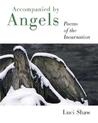 Accompanied by Angels: Poems of the Incarnation by Luci Shaw
My rating: 4 of 5 stars
This is a wonderful collection. In the midst of the stress of the holidays, I was thankful to have a few moments to read these poems, which rekindled a sense of awe at the incarnation, life, death, and resurrection of Christ.
Luci Shaw has a way of making truths that I’ve always known come alive to me in a new way. For example, I love "Mary's Song" for its portrayal of Mary's quiet wonder at her Baby, who she knew was God Himself:
Blue homespun and the bend of my breast
keep warm this small hot naked star
fallen to my arms. (Rest . . .
you who have had so far to come.)
Now nearness satisfies
the body of God sweetly. Quiet he lies
whose vigor hurled a universe. He sleeps
whose eyelids have not closed before.
His breath (so slight it seems
no breath at all) once ruffled the dark deeps
to sprout a world. Charmed by dove’s voices,
the whisper of straw, he dreams,
hearing no music from his other spheres.
Breath, mouth, ears, eyes
he is curtailed who overflowed all skies,
all years. Older than eternity, now he
is new. Now native to earth as I am, nailed
to my poor planet, caught
that I might be free, blind in my womb
to know my darkness ended,
brought to this birth for me to be new-born,
and for him to see me mended
I must see him torn.
And “Mary’s Song” is typical of the poems in this collection. Not every one of the poems were as moving, but some, like this one, are truly marvelous.
Some of my other favorites were “The Meaning of White Oaks,” “One,” “A Blessing for the New Baby,” “Bluff Edge, Whidby Island,” “The Partaking.”
For me, the most moving poem in this book was one near the end entitled “Revolutionary.” It's a powerful expression of the injustice that Christ endured, and the wonder of the love He showed us by going to the cross.
Do you
wince when you hear his name
made vanity?
What if you were not so safe
sheltered, circled by love
and tradition? What if
the world shouted at you?
Could you take the string of
hoarse words -- glutton, wino,
devil, crazy man, agitator, bastard,
nigger-lover, rebel --
and hang the grimy ornament
around your neck
and answer love?
See the sharp stones poised
against your head! Even
your dear friend
couples your name with curses
(“By God! I know not God!”).
The obscene affirmation
of infidelity
echoes, insistent
from a henhouse roof.
Then, Slap! Spit! The whip,
the thorn. The gravel
grinds your fallen knees
under a whole world’s weight
until the hammering home
of all your virtue
stakes you, stranded,
halfway between hilltop
and heaven (neither will
have you).
And will you whisper forgive?
Poems like these leave me speechless.
I hope to read this book again, along with more of Shaw’s books.
12/23/13
His universal grace,
small-folded in a warm, dim
female space - the Word stern-sentenced to be
nine months' dumb --
infinity walled in a womb,
until the next enormity --
the Mighty One, after submission
to a woman's pains,
helpless on a barn's bare floor,
first tasting bitter earth.
Luci Shaw, "Made Flesh"
small-folded in a warm, dim
female space - the Word stern-sentenced to be
nine months' dumb --
infinity walled in a womb,
until the next enormity --
the Mighty One, after submission
to a woman's pains,
helpless on a barn's bare floor,
first tasting bitter earth.
Luci Shaw, "Made Flesh"
Now you are multiplied --
we are your fingers and your feet,
your tender heart -- we
are your broken side.
Take now, and crumble small,
and cast our human flesh on
the world's waters, your contemporary
Shewbread. Feed us
to more than five thousand women and men,
and in our dark, daily flood of living,
pour yourself out again.
from Luci Shaw, "The Partaking"
we are your fingers and your feet,
your tender heart -- we
are your broken side.
Take now, and crumble small,
and cast our human flesh on
the world's waters, your contemporary
Shewbread. Feed us
to more than five thousand women and men,
and in our dark, daily flood of living,
pour yourself out again.
from Luci Shaw, "The Partaking"
11/26/13
It is the light that tugs,
that teaches each
acorn to defy the pull
down, to interrupt
horizontal space.
And falling, filtering
through the pale green leaves,
it is rain that rises,
then, like a spring
at a sapling's heart.
It is wind that trains,
toughens the wood.
It is time that spreads
the grain in rings --
dark ripples in
a slow pond.
From "The Meaning of White Oaks," Luci Shaw
11/14/13
In her preface to her wonderful book The Angles of Light, Luci Shaw gives some great insight on how to read poetry. Here are a few of the points she makes, in her words:
- In the poem the writer has made a bridge, or half a bridge, across the watery expanse of understanding. The half-structure reaches toward your imagination from the poet's side. In order to join it, you, the reader, must extend the other half of the bridge from your side of the riverbank. You must take the risk of reaching toward the constructed work the poet offers you, and in meeting it, join it, so that the images, ideas, emotions, perceptions, music, and rhythm can flow from the poet's mind into your own.
- It's a journey into someone else's mind, into the unknown, into mystery. But as you move forward into it line by line, . . . the way opens up, becomes clear, and the structure holds firm under you despite the feeling that you are entering a cloud. When you reach the other side, you will know that the bridge of the poem has held you and led you into the poet's mind, experience, and emotion.
- For this to happen most effectively, you may want to read the poem aloud, and let its rhythm and the resonant music of its language enter your ear as the words penetrate your eye and the ideas and images reach your mind. This will vastly aid your comprehension of the poem. Read it aloud again. And again. Each time you read it, it will open itself up--make itself more accessible and vivid to you.
- Because a skillful poem often suggests rather than explains, there may be some enigmatic gaps, some silences, some breaks in logic, which you will fill in from your own imagination, your own set of kaleidoscopic impressions.
- A poem is as different from descriptive or expository prose as singing or whistling is from talking. You must come to poetry with a different set of expectations than you would with a sermon on the raising of Lazarus, or a lecture. . . . Where most prose gives us information or instruction, poetry offers reflection on something wonder-full, some event or phenomenon that has caused the poet to express wonder . . .
- A poem rarely attempts to tell the whole story. It's not like a speech with an introduction, four points, a summary, and a conclusion. ... It is more like a small fragment of experience viewed close up. It hints, suggests, touches, probes, without preaching or pushing too hard. Poems are packed with sounds, pictures--the doorways to the inner life of objects, experiences, relationships--the stuff of the extraordinary ordinary.
- As you enter a poem you will need to feel and see it as well as to listen to it and analyze it critically. . . . Poetry is not irrational, but it arises from the logic of the imagination and the senses rather than from the purely linear, rational kind of thought.
- Practice a kind of relaxed concentration. Take time. Breathe deeply. Flow with the lines of words, and bridge your way into each poem with your ears, and your skin, and your nose, and your eyes, and even your tongue. See the word pictures. Pretend your mind is a projection screen on which the poet is shining a series of images.
9/3/12
 The Angles of Light: New and Selected Poems by Luci Shaw
My rating: 5 of 5 stars
This is a collection of wonderful poetry by an outstanding Christian poet. Luci Shaw's poems in this volume are original and subtle, personal and profound, drawing on nature to show that for the Christian, the physical world is not neutral, but sacramental. Shaw reminds us that nature is a means for God to bless us and show us aspects of His glory and His grace. In particular, I love how Shaw uses light as a metaphor throughout the book to communicate the ideas of both enlightenment and beauty.
For me, these poems give a sense of wonder that the physical world can convey to us day by day if we will take the time to slow down and notice. In this way, even though Shaw's poetry is much more free in form, it reminds me of the poetry of Gerard Manley Hopkins.
Here's just a taste from one of my favorites in the book, "We know this to start with." This poem reminds us that we experience the wonder of this God-created, marvelous world through the five senses He gave us.
" . . . Somehow
without witchcraft or chicanery
we collect sounds and colors in a skyward
dish, like fruit in a bowl, and channel them
into verisimilitude--faces talking at us
from the tube's glass eye. Hallways of fog
enfold us in enigma. And then, the marvel of
window glass--how can anything be
hard enough to stop the hand and
hold its smudge while letting through this
soft light? The one wheat kernel that
breeds a thousand--a miracle of
loaves over and over again.
The stars, invisible in the blind day
revealed, thick as pollen, by the absence
of light."
View all my reviews
7/31/12
As Gene Edward Veith has said in The Gift of Art, "Beauty is an appropriate end in itself--the garments [for the tabernacle] were to be made for beauty. The inventor of color, of form, of texture, the author of all natural beauties, values the aesthetic dimension for its own sake. According to the clear statements of Scripture, art has its place in the will of God." . . .
The tragedy is that so many Christians, in their revulsion at the perverse aspects of such art, shun all art, even that which may spring from a God-honoring imagination. . . . The other "Christian" alternative is a conservatism that responds only to kitsch, a sentimental art of the Hallmark greeting card variety that cheapens true sentiment, turning it into sweetness and light or mere moralistic propaganda--no teeth, no guts, no muscle, no reality. No real Christianity, either, if we consider the Creator's work as our powerful, radical model.
Luci Shaw, "Beauty and the Creative Impulse"
The tragedy is that so many Christians, in their revulsion at the perverse aspects of such art, shun all art, even that which may spring from a God-honoring imagination. . . . The other "Christian" alternative is a conservatism that responds only to kitsch, a sentimental art of the Hallmark greeting card variety that cheapens true sentiment, turning it into sweetness and light or mere moralistic propaganda--no teeth, no guts, no muscle, no reality. No real Christianity, either, if we consider the Creator's work as our powerful, radical model.
Luci Shaw, "Beauty and the Creative Impulse"
Beauty matters. It is important to God. . . . Why else would he shape and color fish, birds, insects, rocks, plants, and people with such rich diversity? As my friend Elizabeth Rooney said, "Imagine making something as useful as a tree, as efficient at converting sunlight into food and fuel, as huge and tough as a white oak that can live 300 years, and then decorating it in spring with tiny pink leaves and pale green tassels of blossoms."
Luci Shaw, "Beauty and the Creative Impulse"
Luci Shaw, "Beauty and the Creative Impulse"
When the world was created, it might have seemed to be enough to have it work. To include beauty seems unnecessary for a mechanistic universe. We have been given a sense of the beautiful which can be regarded as gratuitous. Which it is--a gift of pure grace. And our own creation of beautiful things links us with our Creator. God was the first Quilter of prairies, the primal Painter (night skies, ferns, thunderheads, snow on cedars), the archetypal metal Sculptor (mountain ranges, icebergs), the Composer who heard the whales' strange, sonorous clickings and songs in his head long before there were whales to sound them, the Playwright who plotted the sweeping drama of Creation, Incarnation, Redemption, the Poet whose Word said it all.
Luci Shaw, "Beauty and the Creative Impulse"
Luci Shaw, "Beauty and the Creative Impulse"
The church has given considerable attention to Truth and Goodness, to theology and ethics. But too often beauty has escaped us, or we have tried to escape from it. This is partly because of its innovative, experimental aspect, its way of reaching for originality or a new way of expressing an old standard. In many Christian circles this is felt to be dangerous; the pursuit of beauty is seen merely as an option, and a seductive one at that, because beauty can neither be controlled nor programmed.
Luci Shaw, "Beauty and the Creative Impulse"
Luci Shaw, "Beauty and the Creative Impulse"
Subscribe to:
Posts (Atom)